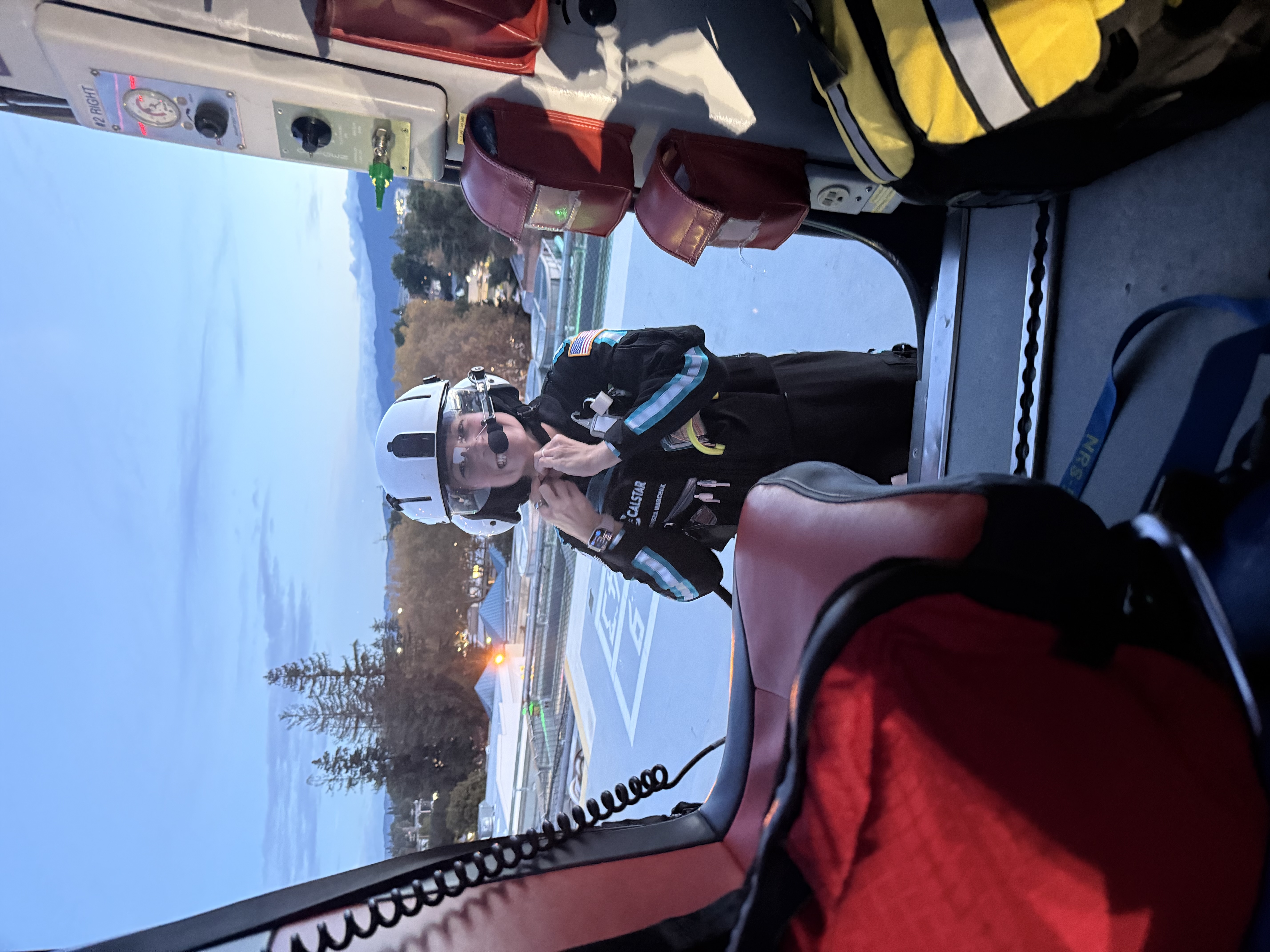
California Flight Nurse Honored After Rare Emergency Procedure Helps Save Critically Burned Patient
11.5.2026
Katherine “Katie” Tribley with REACH Air Medical Services is being recognized for saving the life of a severely burned patient by providing advanced critical care during a transport.
Katherine “Katie” Tribley is accustomed to making difficult decisions at 3,000 feet. As a flight nurse for REACH Air Medical Services (REACH), serving California’s Central Coast, she regularly responds to critically ill and injured patients whose conditions can change in an instant. Last year, Tribley encountered a call unlike any she had faced before. Working alongside her flight partner, she helped save the life of a severely burned patient by establishing an emergency airway and providing advanced critical care during transport.
The incident required one of the rarest and most complex airway interventions in emergency medicine—a procedure many flight clinicians may never perform in an entire career.
That combination of clinical excellence, leadership and commitment to her colleagues recently earned Tribley recognition as a 2026 Stars of Life honoree, the highest honor given by the American Ambulance Association (AAA).
Tribley and flight partner Natasza Marchak were dispatched to transport a patient who was rapidly deteriorating, creating a life-threatening situation with minutes to spare.
Recognizing that conventional airway procedures would not succeed, the team made the critical decision to perform a cricothyrotomy, an emergency surgical airway procedure typically reserved for the most extreme circumstances. The procedure is performed so infrequently that many emergency flight clinicians may never encounter the need for one during their careers.
According to Tribley, this was only the second time in the previous five years that a cricothyrotomy had been performed by the REACH (formerly CALSTAR) team in Salinas.
“The procedure itself was important, but what stands out most is the teamwork,” said Tribley. “We train for these moments, and when the time came, everyone simply stepped up.”
Although securing the airway was a critical milestone, the emergency was far from over. During the approximately 30-minute flight, the patient began showing signs of life-threatening cardiac deterioration. Working in the confined cabin of a medical helicopter, Tribley and her flight partner Marchak relied on advanced critical care training, medications and monitoring equipment carried onboard to identify problems before they progressed. Together, they administered a series of emergency interventions that stabilized the patient and allowed the flight to continue safely.
According to colleagues, the patient ultimately survived and continues to recover—an outcome many considered extraordinary given the severity of the injuries.
But colleagues say Katie’s impact extends far beyond the helicopter.
Over the past several years as Base Clinical Lead, Tribley has strengthened training programs, mentored new clinicians, and fostered a workplace culture built on teamwork and accountability. Together with her teammates, she has helped improve the base and transform a previously underutilized space into a functional environment that encourages ongoing practice and preparation. She champions a growth mindset and emphasizes the importance of preparing for low-frequency, high-risk procedures before they are needed in the field.
“People perform at the level of their training,” Tribley said. “When those critical moments happen, preparation matters.”
Her commitment to education has helped elevate clinical readiness throughout her flight operation.
For the communities served throughout California’s Central Coast, that preparation can make all the difference when the next life-or-death call arrives.
Tribley is one of 33 first responders within REACH’s parent company, Global Medical Response, selected for the 2026 Stars of Life program and will join honorees from across the country in Washington, D.C., in November. The national program recognizes EMS professionals whose service has made a meaningful difference for patients, colleagues, and communities. During the program, honorees will also have opportunities to visit Capitol Hill, meet with lawmakers, and share their experiences in EMS with those shaping policies that affect the profession and the communities they serve.